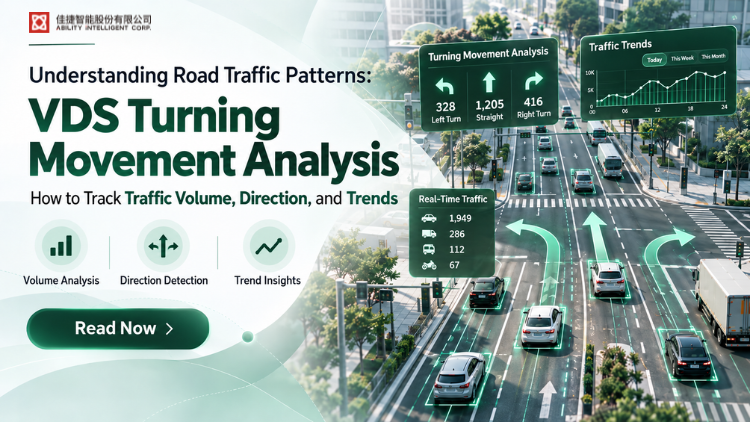
Traffic flow is not simply a matter of whether there are “more or fewer vehicles” on the road. At the same intersection, the proportion of vehicles turning left, turning right, or traveling straight through can vary significantly throughout the day. During peak periods, vehicle mix, average speed, and lane utilization can also directly affect signal timing, road configuration, and overall traffic management.
While manual observation or individual sensing devices can provide basic traffic volume data, they make it difficult to continuously track the direction and complete trajectory of each vehicle. A VDS (Vehicle Detection System) turning movement analysis system uses high-resolution cameras and AI video analytics to automatically identify different vehicle types, follow vehicle trajectories, and calculate the proportions of left-turn, right-turn, and through movements across different time periods, transforming information captured in road video into analyzable traffic data.
How Does VDS Turning Movement Analysis Determine Vehicle Direction?
VDS does more than simply count vehicles passing through a detection point. After cameras capture live road footage, AI models identify and classify different vehicle types, including passenger cars, motorcycles, buses, and trucks.
Multi-object tracking technology then continuously follows the movement trajectory of each vehicle, helping reduce duplicate counts and missed detections in heavy traffic or when vehicles partially obstruct one another. Once a vehicle passes through an intersection, the system uses its complete trajectory to determine whether it turned left, turned right, or continued straight through, then converts traffic volumes in each direction into statistical data.
The overall process can generally be divided into the following steps:
-
- Cameras capture real-time road footage
- AI models detect and classify different vehicle types
- The system continuously tracks individual vehicle trajectories
- Left-turn, right-turn, and through movements are identified
- Traffic volumes and turning movement ratios are calculated for different time periods
- Data is compiled into reports for subsequent traffic analysis
The real purpose of VDS is therefore not simply to determine “how many vehicles are on the road,” but to understand where vehicles are coming from, which direction they are traveling, and how traffic patterns change over time.
Key Factor 1: Why Is Turning Movement Data Important Beyond Traffic Volume?
Knowing that 3,000 vehicles pass through an intersection every hour does not fully describe the actual traffic conditions at that location. If most vehicles are turning left, for example, queues may quickly form in the left-turn lane. If a large proportion of vehicles travel straight through the intersection, different signal timing and lane configurations may be required.
Turning movement analysis separately calculates left-turn, right-turn, and through traffic volumes, giving traffic management authorities a clearer understanding of actual demand in each direction. As these records accumulate over time, they can also serve as a reference for signal timing adjustments, road configuration, and dedicated lane planning. In other words, traffic volume tells us “how many vehicles there are,” while turning movement analysis goes one step further by showing “where those vehicles are going.”
Key Factor 2: Different Vehicle Types Have Different Impacts on the Road
Traffic is not made up of a single type of vehicle. Passenger cars, motorcycles, buses, and trucks differ in the amount of road space they occupy, their operating speeds, and their turning behavior. As a result, total traffic volume alone may not fully reflect how a road is actually being used. Using AI video recognition, VDS distinguishes between different vehicle types while also analyzing traffic volume, vehicle speed, and lane occupancy.
For example, a road with a high proportion of trucks during a particular period may require different traffic management and road configuration considerations from one primarily used by motorcycles or passenger cars. Vehicle classification therefore takes traffic data beyond a single total count and provides a more detailed picture of actual road usage patterns.
Key Factor 3: How Can Real-Time Data Support Traffic Management?
Traffic flow analysis is useful not only for long-term planning but also for real-time traffic management. VDS rapidly processes traffic volume and turning movement data and can integrate with intelligent traffic signals or traffic management platforms. When traffic in a particular direction increases significantly, this information can serve as a reference for dynamic signal adjustments and real-time monitoring.
At high-traffic locations such as urban arterial roads, intersections, and expressway ramps, real-time information helps traffic management authorities understand:
-
- Real-time traffic volumes in different directions
- Vehicle speeds and lane utilization
- Whether abnormal traffic volumes occur during specific periods
- Which turning movements are more likely to create queues or congestion
The real value lies not in adding more surveillance screens, but in transforming road video footage into information that traffic management systems can directly use.
Key Factor 4: Historical Traffic Data Reveals Long-Term Trends
Real-time traffic information primarily answers the question, “What is happening on the road right now?” Historical records, on the other hand, help reveal whether traffic patterns are changing over time.
VDS continuously collects information on traffic volume, vehicle speed, and road usage, while generating daily, weekly, and monthly reports. By comparing data across different periods, directions, and vehicle types, management teams can identify recurring turning patterns and broader traffic trends.
For example:
-
- Do turning ratios differ between weekdays and weekends?
- Are peak traffic periods gradually shifting earlier or later?
- Is traffic in a particular direction at an intersection continuing to increase?
- Have traffic patterns changed after the introduction of a new road or traffic measure?
These insights provide valuable reference points for road planning, dedicated lane design, and intelligent transportation strategies.
How Does VDS Maintain Reliable Analysis in Complex Road Environments?
Real-world road conditions are not always ideal for video analysis. Low-light conditions at night, rain or fog, heavy traffic, and vehicle occlusion can all affect recognition performance. To maintain reliable analysis under these conditions, VDS can incorporate infrared illumination, multi-camera configurations, and optimized AI models. Camera footage may also be combined with sensing data from radar, geomagnetic sensors, or GPS to improve analytical stability in more complex environments.
The computing architecture can be configured using edge processing or cloud-based/centralized analysis according to site requirements. At intersections where rapid response is important, data can be processed locally at the edge. When information from multiple intersections needs to be consolidated, statistical results can instead be transmitted to a central platform for unified management. The most suitable architecture depends on factors such as the number of intersections, network conditions, real-time processing requirements, and overall management needs.
Where Can VDS Turning Movement Analysis Be Applied?
On urban arterial roads and intersections, VDS can analyze turning ratios and traffic density to support signal timing and road configuration adjustments. At interchange ramps and expressway entrances, it can help monitor merging traffic as well as inbound and outbound vehicle flows. In industrial parks, commercial districts, smart parking facilities, and large-scale event venues, VDS can also analyze vehicle entry, exit, and movement directions to provide a clearer view of entrance traffic conditions and congestion. Over time, accumulated records can further contribute to urban transportation planning and road network analysis.
The system can also support event detection for situations such as wrong-way driving, illegal turns, right turns on red, or improper use of designated turning lanes. Based on operational needs, these capabilities can also support traffic safety and enforcement applications. For deployment, the solution supports cloud, on-premises, or hybrid architectures and provides both API and no-code integration options. The official solution also uses AES-256 encryption for data security, allowing deployment to be planned around organizational cybersecurity requirements and existing system environments. Integration with existing traffic management systems and smart city platforms can be configured to meet specific project requirements.
From “Seeing Traffic” to Analyzable Transportation Data

Want to learn more about Smart Buildings, AI Video Analytics, and AIoT applications?
Follow Ability Intelligent on Facebook for the latest industry insights and updates.
