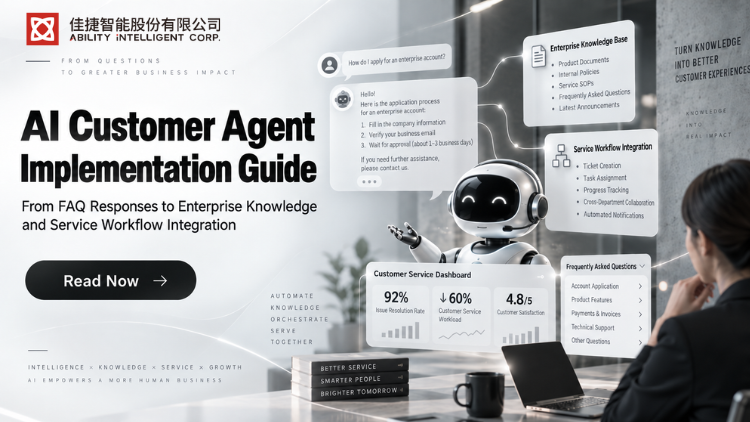
Businesses handle large volumes of repetitive customer inquiries every day, including order status, membership benefits, service plans, payment methods, return and refund procedures, and instructions for different products and services. As inquiry volumes grow, relying entirely on customer service representatives to handle each request individually not only requires significant manpower, but can also be affected by service hours, fragmented communication channels, and the speed at which information is updated.
The role of an AI Customer Agent goes beyond replacing traditional FAQs with automated responses. It enables AI to understand customer needs, connect with existing enterprise data and backend systems, provide consistent responses across different service channels, and even execute specific service workflows. Ability Intelligent’s current AI Customer Agent solution is powered by LIVEX.AI, supporting omnichannel interactions, enterprise system integration, and task execution, allowing AI to move beyond answering questions and participate directly in customer service operations.
What Is the Difference Between an AI Customer Agent and a Traditional Chatbot?
Traditional chatbots generally respond based on predefined questions and answers, making them suitable for common inquiries with clear rules and relatively limited variation.AI Customer Agents go a step further. In addition to understanding natural language, they can interpret user intent based on the conversation, connect to enterprise systems to retrieve relevant information, and execute subsequent tasks according to predefined rules.
For example, when a customer asks about an order or membership plan, the system does not simply return a fixed response. After completing the necessary identity verification and permission-related processes, it can connect with backend data to handle inquiries, plan changes, promotional offers, refunds, or other service tasks.
The key difference, therefore, is not simply whether AI can “respond more like a human,” but whether it can move from answering questions to understanding needs, retrieving information, and executing service workflows.
Key Factor 1: Start with High-Volume, Repetitive Inquiries to Reduce Customer Service Workload
When implementing AI customer service, businesses do not need to automate every service scenario from the beginning. A more practical approach is to first identify the most frequent inquiries that follow relatively clear rules, such as:
-
- Order and delivery inquiries
- Membership and service plan information
- Payment-related questions
- Return and refund procedures
- Common product or service inquiries
- Basic operation and usage instructions
These inquiries often consume a significant amount of customer service time, even though most of them have clearly defined information sources and handling procedures. By allowing AI to take on high-frequency, repetitive inquiries first, customer service representatives can focus their time on cases that require further judgment, communication, or exception handling. LIVEX.AI is also designed to go beyond automated FAQ responses by incorporating repetitive tasks into automated workflows while providing support for human agents in more complex customer service situations.
Key Factor 2: Ensure AI Responses Are Based on the Information the Business Actually Uses
Whether AI can answer a question is one issue; whether its response accurately reflects the company’s actual service information is another. When a business simultaneously operates a corporate website, membership database, order management system, CRM, POS, ERP, and other backend systems, customer service representatives often need to search across multiple platforms to find the required information.
An AI Customer Agent can retrieve relevant information through system integration, allowing responses to go beyond generic text and instead reflect actual enterprise data and the customer’s specific situation. LIVEX.AI can currently integrate with existing enterprise systems such as CRM, POS, ERP, and marketing databases. It can also provide differentiated interactions based on membership tiers, purchasing behavior, or other available customer data. Before implementing an AI Customer Agent, businesses should therefore first determine: what information AI is permitted to access, which information must be retrieved in real time, and which data or actions require specific permission controls.
Key Factor 3: Move Beyond Answering Questions by Connecting AI to Service Workflows
If customers still need to open another website, search for a form, or contact a human representative after receiving an answer, gaps remain in the overall service journey. The concept of Agentic AI is to allow AI to take the next step after understanding the customer’s needs and execute specific tasks according to enterprise-defined rules.
Depending on the service scenario, this may include:
-
- Checking order information
- Assisting with service plan changes
- Providing promotional offers or related service information
- Initiating refund or return procedures
- Assisting with upgrades or renewals for subscription-based services
LIVEX.AI supports API-based and other integration methods to connect with brand backend systems, allowing AI to extend beyond the conversational interface and interact with actual service workflows. This is one of the most important distinctions between an AI Customer Agent and a basic FAQ system. The objective is not only to explain “what the customer should do,” but also to reduce the number of steps between the initial inquiry and the completion of the requested service.
Key Factor 4: Can Customer Service Information Remain Consistent Across Different Channels?
Customers today do not necessarily contact a company through its website alone. The same customer may first search for information on a website, then ask a question through LINE, and later use a phone service, mobile app, or physical store. If each channel follows a different customer service logic, management becomes more difficult for the business, while customers may receive inconsistent information.
AI Customer Agents can be deployed across multiple touchpoints, including Web, App, voice, QR Code, and Kiosk interfaces, enabling businesses to provide more consistent service logic across both online and offline interactions. The solution also supports multilingual and multi-scenario applications. For businesses, omnichannel service does not simply mean “placing a chatbot everywhere.” The real objective is to ensure that different channels rely on the same service information or use workflows that can connect seamlessly with one another.
AI Does Not Necessarily Need to Completely Replace Human Customer Service
Not every inquiry is suitable for full AI automation. Special customer complaints, complex decisions, exceptional situations, or cases requiring more extensive communication may still need to be handled by human customer service representatives. An AI Customer Agent can therefore also serve as an assistive tool for customer service teams.
For example, AI can first summarize the customer’s issue, provide relevant information or knowledge content, and generate a conversation summary and other necessary context when a case needs to be transferred to a human representative. This reduces the time required for the agent to reconstruct the entire background of the conversation.
LIVEX.AI’s AI Co-pilot capabilities include self-service handling of common inquiries, Agent Assist, real-time summarization, knowledge recommendations, and escalation or transfer functions. Rather than treating the choice as “AI or human customer service,” a more practical approach is to let AI handle high-frequency, standardized interactions while human representatives focus on cases that require experience, judgment, and more nuanced communication.
What Should Businesses Consider Before Implementing an AI Customer Agent?
Implementing an AI Customer Agent does not require businesses to cover every customer service channel and workflow at once. The solution can be deployed modularly, beginning with a single service scenario and gradually expanding to additional channels and applications.
Before implementation, businesses can begin by evaluating the following areas:
-
- Which repetitive inquiries are currently handled most frequently by the customer service team?
- What enterprise information does AI need in order to answer customer questions?
- Which service workflows can be integrated with existing systems through APIs?
- Which situations should be escalated to human customer service representatives?
- Which websites, apps, voice channels, or physical service touchpoints will the AI be deployed on?
- What requirements does the organization have regarding data security, cloud deployment, or on-premises deployment?
For deployment, the current solution supports cloud, on-premises, and hybrid architectures, as well as API and no-code integration options. The official solution page also states that AES-256 encryption is used for data security, allowing deployment to be planned according to enterprise cybersecurity requirements and existing IT environments.
Moving from Automated Responses to Complete AI-Powered Service Workflows

Want to learn more about Smart Buildings, AI Video Analytics, and AIoT applications?
Follow Ability Intelligent on Facebook for the latest industry insights and updates.
