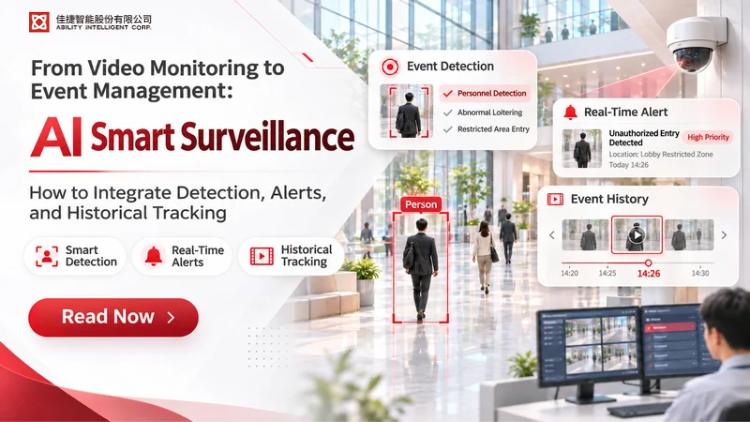
In commercial buildings, corporate campuses, parking facilities, and public infrastructure, surveillance cameras are often required to operate around the clock. As the scope of monitoring expands, a management center may receive dozens or even hundreds of video streams simultaneously, yet only a small number of abnormal events typically require immediate attention.
Traditional surveillance relies primarily on personnel monitoring live video feeds or reviewing recorded footage after an incident. When situations such as abnormal loitering, unauthorized entry into restricted areas, or improper vehicle occupation occur, the absence of real-time notifications and complete event records may prevent management personnel from responding promptly. Subsequent investigations may also require considerable time to review and compare footage from multiple cameras.
AI-powered surveillance integrates video analytics, event detection, and management platforms to transform abnormal conditions captured on camera into traceable event information. By combining real-time alerts, video playback, and historical reporting, it helps organizations establish a more systematic approach to surveillance and security management.
How Does AI-Powered Surveillance Differ from Traditional Video Surveillance?
Traditional video surveillance primarily focuses on providing live footage and storing recordings. Although management personnel can use surveillance systems to monitor on-site conditions, they must still determine which activities require attention.
AI-powered surveillance takes this a step further by using video analytics to automatically identify specific abnormal conditions based on predefined monitoring zones, target objects, and event criteria. For example, when a person crosses a designated boundary, a vehicle remains in a prohibited area for an extended period, or an unusual object is detected, the system can generate the corresponding event and transmit the information to a management platform.
These events can be managed alongside timestamps, camera locations, and relevant video footage. Rather than relying entirely on continuous monitoring of multiple video feeds, personnel can prioritize reviewing abnormalities identified by the system. The key difference therefore lies in the management approach: traditional surveillance primarily organizes information around video footage, while AI-powered surveillance enables video and related information to be organized and managed around individual events.
From Video Detection to Event Creation: How Does the System Work?
The event management process in AI-powered surveillance typically begins with cameras capturing on-site video. AI models then analyze the behavior of people, vehicles, or other objects to determine whether predefined event conditions have been met.
Consider a designated fire access lane within a parking facility. Management personnel can define a monitoring zone and establish vehicle dwell-time conditions for the no-parking area. If a vehicle remains within the designated zone long enough to meet the event-triggering criteria, the system can generate an abnormal event notification for personnel to review.
The overall process, from video capture to event management, can be divided into six steps:
-
- Video Capture: Cameras continuously provide live footage of designated monitoring areas.
- AI Detection: The system analyzes targets such as people, vehicles, and unusual objects.
- Event Condition Evaluation: Events are identified based on predefined criteria, including monitoring zones, movement direction, or dwell time.
- Event Creation: The system generates an abnormal event record and associates it with relevant video footage.
- Alert Notification: Event information is delivered to the management center or integrated systems.
- Historical Tracking: Event records and video data are retained for subsequent retrieval and analysis.
More Alerts Do Not Necessarily Mean Better Monitoring: Effective Event Assessment Matters
As surveillance systems begin automatically detecting abnormalities, management teams may encounter another challenge: excessive alerts can increase the workload involved in reviewing and verifying events. For example, an entrance may experience heavy pedestrian traffic during peak hours. If the monitoring conditions are overly sensitive, normal movement may repeatedly trigger notifications. Effective event management must therefore account for how each environment is actually used, including monitoring coverage, triggering criteria, event duration, and on-site conditions.
When an alert is generated, management personnel need more than a notification; they also need quick access to the corresponding surveillance footage. Certain AI event detection devices support event-triggered video pop-ups, electronic map integration, and API-based alert notifications, helping management centers identify the event location and assess on-site conditions.
The appropriate notification recipients, event assessment rules, and subsequent response procedures should be planned according to the organization's existing management policies and system integration requirements. This helps ensure that alerts provide meaningful information for operational decision-making.
The objective is not to generate more alerts, but to deliver the right alert to the right personnel at the right time. When event conditions are properly configured, AI-powered surveillance can reduce unnecessary notifications while helping organizations focus on incidents that truly require attention.
How Does Historical Tracking Make Surveillance Records Easier to Retrieve?
After an abnormal event occurs, management personnel often need to review the full sequence of events. Traditional video searches typically require personnel to locate footage by camera position and time range. If the exact time of an incident is unclear or multiple monitoring areas are involved, retrieving the relevant recordings can become time-consuming.
An event-driven management approach associates abnormal events with corresponding video footage, allowing personnel to review timestamps, camera locations, and historical recordings through event records. For example, an IID (Incident Information Detection) system can support historical video playback, target tracking, entry and exit time records, and security event reports. As event data accumulates, it can also provide insight into recurring abnormalities within specific areas. Historical records can help determine whether unauthorized vehicle stops frequently occur near a parking entrance or whether intrusion alerts are repeatedly triggered in a particular corridor during certain periods.
Beyond supporting individual incident investigations, these records can serve as a reference for refining detection conditions, adjusting security patrol arrangements, and improving on-site management policies. Historical event records can also help organizations identify recurring risks, optimize security policies, support compliance requirements, and improve audit readiness. Instead of viewing incidents as isolated events, management teams can use accumulated event data to continuously improve security operations over time.
How Can Multiple Monitoring Areas Be Managed Through a Centralized Architecture?
When an organization manages multiple floors, buildings, or geographically distributed facilities, surveillance requirements often involve video systems, access control, sensing devices, and other management platforms. If each area stores and manages information independently, personnel may still need to search across multiple systems whenever an abnormal event occurs.
A smart surveillance management platform can connect front-end devices, backend servers, and management centers through a centralized architecture. On-site devices collect video and equipment information, while backend infrastructure handles video recording and archiving, event management, alert notifications, and historical playback. The management center then provides a unified view of surveillance status and event data.
Smart surveillance event management solutions can integrate AI video analytics, IoT devices, and management platforms, supporting centralized or distributed deployment architectures. APIs can also enable data exchange with other systems, allowing the surveillance infrastructure to be configured according to the scale and requirements of different environments.
For example, within a corporate campus, office buildings may prioritize personnel access and public-area security, parking facilities may focus on vehicle dwell times and entrance conditions, while campus perimeters may require boundary-crossing and intrusion detection. Although each area may use different detection criteria, event information can be centrally presented according to the system configuration, reducing the need for management personnel to switch between multiple independent platforms.
What Practical Requirements Should Be Considered Before Implementing Event Management?
The effectiveness of AI-powered surveillance depends not only on recognition technology but also on actual site conditions and established management workflows.
Organizations should first confirm whether monitoring coverage, camera angles, and image quality are suitable for the intended detection requirements. Appropriate event criteria can then be established for different areas. Environments involving complex pedestrian and vehicle movements, challenging lighting conditions, or visual obstructions should also be evaluated during system planning and testing.
In addition, organizations need to determine who should receive notifications when an abnormal event occurs, how incidents should be verified, and whether integration with existing access control, alarm, or other management platforms is required.
The storage methods, access permissions, and retention periods for historical footage and event records should also be planned in advance according to operational requirements and applicable regulations. The objective is not to equip every camera with identical capabilities, but to ensure that monitoring conditions, notification mechanisms, and data management workflows are appropriately coordinated across different areas.
Turning Surveillance Footage into Event Data for Continuous Management
When surveillance cameras are used solely to provide live video, monitoring effectiveness depends heavily on whether personnel notice abnormal activity in time. Through AI detection, real-time alerts, and historical tracking, organizations can extract critical information from large volumes of footage and organize it into event records, providing a clearer basis for incident verification, subsequent investigations, and long-term analysis.
Event management also makes surveillance data more valuable for continuous improvement. By reviewing the types of abnormalities, occurrence patterns, and response requirements across different monitoring areas, organizations can make more informed adjustments to surveillance configurations and on-site management practices. The transition from video monitoring to event management enables AI-powered surveillance to move beyond live viewing and retrospective footage review. By continuously generating event information that can be identified, communicated, and tracked, organizations can establish a more systematic and effective approach to security management.
Ultimately, this enables organizations to reduce response times, improve situational awareness, strengthen operational oversight, and make better-informed security decisions across their facilities. Rather than relying solely on personnel to monitor video streams, organizations can use AI-powered surveillance to transform video footage into actionable information that supports faster response, more efficient investigations, and long-term security improvement.

Want to learn more about Smart Buildings, AI Video Analytics, and AIoT applications?
Follow Ability Intelligent on Facebook for the latest industry insights and updates.
