Late at night, a critical piece of production equipment in a factory suddenly begins experiencing abnormal vibrations. Equipment sensors detect readings exceeding predefined thresholds, production-line cameras simultaneously capture the surrounding environment, and access control records indicate that no maintenance personnel have recently entered the area. The challenge is that this information is often scattered across different systems, requiring management personnel to manually retrieve equipment records, review video footage, and cross-check access logs to understand what has happened. By the time the situation is confirmed, the equipment may already have stopped operating, potentially disrupting production.
This is a common challenge for enterprises pursuing smart facility management and digital transformation. Although cameras, sensors, access control devices, industrial IoT equipment, and various management platforms may already be deployed, disconnected systems often leave managers with fragmented information rather than a complete understanding of on-site conditions.
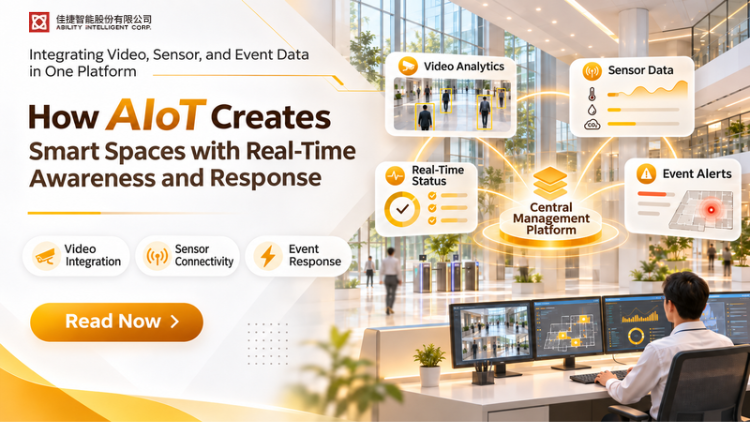
AIoT (Artificial Intelligence of Things) is designed to address these challenges. By integrating AI, IoT devices, edge computing, and management platforms, AIoT enables systems to go beyond data collection to analyze on-site conditions, generate events, and initiate subsequent management workflows. This allows smart environments to evolve from simply having connected devices to being able to sense, analyze, and respond to real-world conditions.
AIoT Is More Than Simply Combining AI and IoT
The core value of IoT lies in enabling devices to collect data and communicate with one another, while AI adds the ability to interpret what that data means. For example, cameras continuously capture images of people, vehicles, and on-site activities; environmental sensors monitor temperature, humidity, and air quality; equipment sensors report vibration, electrical current, pressure, and operating conditions; and access control and parking systems record personnel and vehicle movements.
When these systems operate independently, management personnel can only access fragmented information across separate platforms. However, when the data is integrated into a unified architecture, the system can establish relationships across multiple data sources, such as:
-
- Whether equipment abnormalities occur alongside production-line interruptions
- Whether unauthorized personnel have entered restricted areas
- Whether personnel were working on-site when an equipment alert occurred
- Whether abnormal events are associated with changes in environmental conditions
The fundamental value of AIoT therefore does not depend on how intelligent an individual device is, but on enabling video, sensor, equipment, and event data to work together within a unified operational workflow.
Layer 1: Enabling Smart Environments to Sense What Is Happening
The first step in building a smart environment is continuously collecting on-site information, with different devices monitoring different aspects of operations:
-
- Cameras monitor people, vehicles, and activities within the environment
- Sensors monitor equipment and environmental conditions
- Access control systems record entry and exit information
- Production equipment continuously transmits operational data
- Inspection devices generate various inspection records
In a smart factory, for example, cameras can monitor production-line operations and personnel activities, equipment sensors continuously track machinery conditions, and access control systems verify whether personnel are authorized to enter designated areas.
Individually, each data source provides only a partial view of on-site conditions. When this information is centrally integrated, management teams can gain a more comprehensive understanding of factory operations. The first major value of AIoT is therefore transforming information that previously relied on manual inspections or fragmented management systems into digital data that can be continuously collected, analyzed, and utilized.
Layer 2: Using AI to Identify the Data That Truly Matters
Smart environments can generate enormous volumes of video and sensor data every day, yet only a small proportion of that information typically requires immediate management attention. AI plays a critical role in identifying meaningful changes and potential abnormalities within these large datasets.
In video analytics, for example, AI can detect people and vehicles, recognize license plates and personal protective equipment (PPE), and identify events such as unauthorized entry into restricted areas, prolonged presence in hazardous zones, abnormal crowd gatherings, or falls.
At the equipment level, AI can analyze abnormal vibrations, changes in power consumption, rising temperatures, and potential signs of equipment failure, transforming individual data fluctuations into actionable events that require attention.
Not all of this analysis needs to take place in a central data center. AI Cameras, AI Boxes, and Edge AI computing devices allow certain processing tasks to be performed closer to where the data is generated:
-
- AI Camera: Performs on-device detection and recognition of people, vehicles, and predefined events
- AI Box: Enhances existing surveillance systems with AI analytics capabilities
- Server: Supports centralized computing and event management for large-scale facilities
Different computing architectures can be deployed flexibly according to facility scale and real-time processing requirements. Instead of transmitting all raw data to a central system before analysis begins, enterprises can allocate computing resources where they are most effective, balancing real-time responsiveness with overall system performance.
Layer 3: Moving from Event Detection to Real-Time Response
Detecting an abnormal event is only the first step. The real value of intelligent operations lies in whether the detected event can immediately enter an established management workflow.
When AI identifies an abnormality, the system can automatically create an event record, issue alerts, display relevant video footage, connect with existing management platforms, and initiate subsequent actions according to predefined rules.
For example, when AI detects unauthorized personnel entering a hazardous work area, the system can perform the following steps:
-
- Automatically create an abnormal event record
- Notify the management center
- Display live video footage from the affected area
- Alert supervisors or safety management personnel
- Retain complete event records for subsequent tracking and auditing
Through event management, alert notifications, and API integration, video analytics and sensor data can exchange information with existing enterprise systems, establishing a more complete management workflow:
Sensing → Analysis → Notification → Response
Practical Example: How Can AIoT Improve Smart Factory Management Efficiency?
Consider a manufacturing facility that integrates AI video analytics cameras, equipment vibration sensors, temperature and environmental sensors, personnel access control systems, and an AI event management platform.
When vibration readings from a CNC machining system suddenly exceed normal thresholds, the integrated system can simultaneously collect information from multiple sources:
-
- Equipment sensors report abnormal readings
- AI identifies a potential equipment anomaly
- Cameras provide corresponding live footage of the equipment area
- The system checks whether maintenance personnel activity records are available
- The management platform automatically generates an alert
The maintenance supervisor can then receive an immediate notification, review relevant video footage and equipment information through the platform, and arrange for engineers to inspect the machinery.
If an issue such as bearing wear is identified early, maintenance can be scheduled before the equipment experiences a major failure, reducing the risk of unexpected downtime and production interruptions. Processes that previously depended on manual inspections and retrospective data searches can therefore benefit from earlier detection and faster response through AIoT.
Why Is Data Integration More Important Than Deploying Additional Devices?
When pursuing smart operations, enterprises often begin by adding more devices. However, increasing the number of devices does not necessarily improve management efficiency. If every new device also introduces another independent platform, management personnel may end up spending even more time switching between systems, comparing information, and retrieving records.
The key to AIoT is therefore not the quantity of devices deployed, but the ability to effectively integrate:
-
- Video data
- Sensor information
- Equipment status
- Event records
- Historical data
The purpose of integration is not to display every piece of information on a single screen. Instead, it is to ensure that relevant information from different sources can be quickly correlated and compared when needed, helping management teams understand on-site conditions and make better-informed decisions.
Moving Beyond Connected Devices Toward Truly Responsive Smart Environments
The transformation enabled by AIoT goes beyond adding AI capabilities to individual devices. It fundamentally changes how information flows from the physical environment to management systems.
When planning a smart environment, enterprises can begin by addressing several key questions:
-
- What information about people, vehicles, equipment, or environmental conditions needs to be monitored?
- Which data requires real-time analysis, and which is better suited for centralized processing?
- What conditions should be defined as events requiring attention or action?
- Which personnel or systems need to be notified when an event occurs?
- Can existing cameras, sensors, and management platforms continue to be integrated and utilized?
- Will historical data be needed for statistical analysis and improved decision-making in the future?
The real objective of AIoT is not to deploy more devices, but to establish a complete and connected information flow.
When cameras capture on-site activities, sensors monitor environmental and equipment conditions, AI identifies critical events within large volumes of data, and management platforms translate those findings into notifications and follow-up actions, smart environments can truly develop the ability to sense, analyze, and respond.
This is what enables smart environments to move beyond simply “having access to data” toward “understanding what is happening and taking timely action.”

Want to learn more about Smart Buildings, AI Video Analytics, and AIoT applications?
Follow Ability Intelligent on Facebook for the latest industry insights and updates.
