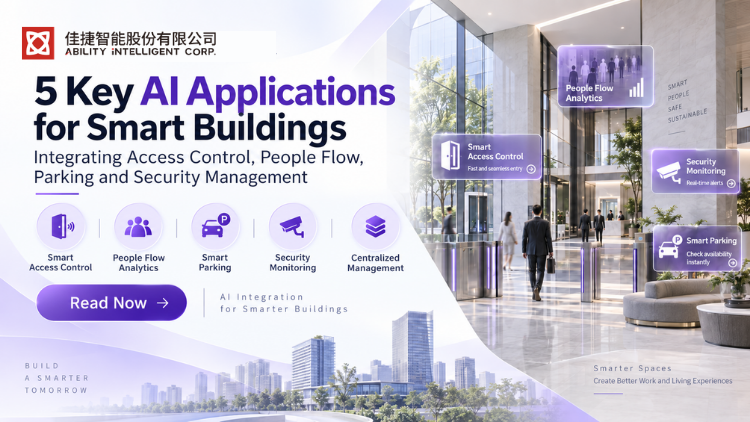
A building experiences many different management events every day, from employee access and visitor registration to vehicle entry, people flow changes, equipment operation, and environmental monitoring. When this information is distributed across separate systems, management teams often need to switch between access control, surveillance, parking, equipment, and environmental monitoring platforms to understand the full situation.
The core of smart building management is not simply adding more automated devices. It is about integrating previously fragmented information through AI video analytics, access control systems, IoT sensors, and backend management platforms. From personnel access and vehicle management to abnormal events, equipment status, and environmental conditions, information can be continuously recorded and analyzed within a unified management architecture, gradually shifting building operations from isolated management toward centralized control. This approach aligns with the Smart Building Management Solution (ICMS), which integrates video surveillance, AI analytics, access control, and environmental monitoring into a single management platform.
Smart Building Management Is More Than Just Connecting Devices
In traditional buildings, surveillance systems handle video recording, access control systems manage personnel entry and exit, parking systems handle vehicles, and environmental sensors monitor air quality, temperature, and humidity. Each system can perform its own function, but when management teams need to understand exactly what happened in a specific area at a particular time, fragmented information can increase the time required for searching and decision-making.
Smart building management goes a step further by integrating data from different sources into a unified management architecture. On-site cameras, access control readers, control panels, and sensors continuously collect video, access records, and equipment status information. Server-room systems then centralize the data and handle recording, event alerts, permission management, and scheduling. Finally, the management center provides a unified view of both real-time and historical information across different areas.
The real challenge that smart building management addresses is therefore not simply whether devices are connected, but whether information related to people, vehicles, spaces, equipment, and environmental conditions can be linked together to provide a more complete basis for management when incidents need to be handled.
Application 1: Smart Access Control — Expanding from Card-Based Entry to Personnel and Visitor Management
Access control is one of the most fundamental security components in building management. Traditional access control systems generally focus on card authentication or permission verification to determine whether an individual is authorized to enter a specific area. However, in corporate headquarters, office buildings, residential communities, or large campuses, management requirements often extend to visitor management, floor-specific access permissions, and access records for critical areas.
Smart building systems can integrate access control records with video surveillance and, depending on site requirements, incorporate technologies such as facial recognition. This allows management teams not only to see that a specific card has passed through an access point, but also to verify entry and exit activity alongside video events within the same platform. Card permissions, operation logs, and related reports can also be centrally managed, reducing the need to repeatedly search across separate systems.
For example:
-
- General office areas can be accessed according to employee permissions
- Server rooms or critical areas can be assigned higher access restrictions
- Visitors can be managed according to site-specific access rules
- The management center can centrally review access records across different floors
Access control therefore becomes more than simply opening and closing doors. It becomes an important part of overall personnel security management.
Application 2: AI People Flow Analytics — Understanding How Spaces Are Actually Used
Knowing how many people entered a building today is only the most basic level of people flow data. For building management, it is more important to understand how different areas are actually being used. For example, which floors have the highest concentration of people? When are public areas most heavily used? Do certain entrances frequently experience large volumes of traffic?
Through AI video analytics and people flow detection, management teams can gain deeper visibility into how people enter, exit, and move through different spaces. Long-term data can also be used to analyze building utilization and space usage.
This information can further help management teams evaluate:
-
- Whether lobbies and public areas frequently experience crowd concentration
- The actual utilization rate of different floors and zones
- Whether additional service or management personnel are needed during peak periods
- Whether the current space layout matches actual usage patterns
As people flow data continues to accumulate, management decisions no longer need to rely solely on experience and can gradually be supported by actual usage data.
Application 3: From License Plate Recognition to Parking Management — Bringing Vehicle Access into the Building Management System
For office buildings, residential communities, corporate campuses, and public facilities, parking areas are often an important part of daily building operations. If parking, access control, and visitor management systems operate independently, management processes may require separate handling of data and permission settings. As the scale of operations grows, fragmented processes can increase the workload for on-site staff.
Smart building systems can integrate license plate recognition, vehicle access, parking management, and visitor information into a unified management architecture. For example, office buildings can integrate license plate recognition, parking guidance, and visitor management. Residential communities can coordinate resident access control with vehicle management, while schools and campuses can implement vehicle access control based on operational requirements.
The role of smart parking within a building is therefore not simply to allow vehicles to enter and exit smoothly. It is about connecting vehicle and personnel management information to reduce information gaps created by separate management processes at different access points.
Application 4: Proactive AI-Based Anomaly Detection — Moving Beyond Manual Security Patrols
Surveillance cameras can record continuously, but if no one is actively monitoring the footage, many abnormal events may still remain unnoticed until after they occur. AI video analytics can enhance existing surveillance systems by evaluating specific types of events. For example, once monitoring rules are defined for critical areas, the system can generate an event and notify management personnel when it detects abnormal lingering, loitering, unauthorized intrusion, or other predefined conditions.
This type of application is particularly suitable for public areas, entrances and exits, parking facilities, campus perimeters, or critical infrastructure that requires continuous monitoring. For example, a person briefly passing through a normal corridor may not require any action. However, if that person remains in a restricted area for an extended period or enters a designated space outside authorized hours, further review by management personnel may be necessary.
The role of AI is not to completely replace on-site staff, but to help identify events that deserve attention from large volumes of video footage, allowing security management to gradually shift from passive monitoring toward an event-driven management model.
Application 5: Integrating Environmental and Equipment Data — Extending from Building Security to Building Condition Management
Building management involves more than personnel and security. It also requires continuous visibility into the operational status of the building itself. Smart building systems can integrate IoT sensors for PM2.5, CO₂, temperature, humidity, and other environmental indicators, enabling management teams to understand environmental conditions across different spaces in real time. Equipment status can also be displayed within the same management platform, reducing the long-term fragmentation of environmental and equipment information across different interfaces.
As this data continues to accumulate, it can be used for more than displaying values at a specific point in time. It can also support equipment management, environmental monitoring, and building operations analysis. The platform can further incorporate AIoT analytics and predictive maintenance applications to help management teams gain a clearer understanding of overall building conditions.
For example:
-
- When CO₂ levels rise, management teams can review space utilization and environmental conditions
- Space utilization and environmental data can be compared across different floors
- Equipment operating status can be continuously monitored
- Long-term records can support future maintenance and operational planning
Smart building management therefore extends beyond security and also covers building operations and environmental management.
Why Should These Five Functions Be Integrated into a Single Platform?
Access control, surveillance, parking, people flow analytics, and environmental sensing are not new technologies when viewed individually. The key difference in smart building management lies in whether these systems can communicate and work together. For example, when the management center receives an abnormal event alert from a specific area, the ability to review live video, relevant access records, and the event timestamp within the same platform can help personnel verify the situation more quickly.
If an organization manages multiple buildings or locations, the same interface can also be used to review video, access control records, alerts, and equipment data across different sites. The purpose of integration is therefore not to place every piece of information on a single screen, but to reduce information gaps between systems and provide management teams with more complete context when responding to events.
What Systems and Devices Need to Work Together in a Smart Building?
Smart building management is not achieved by installing a single software platform. It is built through the coordination of on-site devices, server-room systems, and a centralized management center. On-site devices can include cameras, access control readers, control panels, and environmental sensors that collect video, access records, and equipment data.
Server-room infrastructure can include management servers and storage systems that handle video recording, event alerts, scheduling, and permission management. The management center can then use a browser or management interface to centrally review live video, access records, alerts, and related reports. APIs can also be used for further integration with other platforms.
When planning a smart building system, organizations can begin by confirming:
-
- Which personnel and areas require access control management
- Which spaces require people flow or utilization analysis
- Whether parking and visitor management need to be integrated
- Which abnormal events require proactive AI detection and notification
- Which equipment and environmental indicators need to be monitored
- Whether multiple buildings or sites need to be managed centrally
The goal is not to deploy every smart function at once. Instead, organizations should first identify the most fragmented, labor-intensive, or time-sensitive parts of their current management processes, then integrate functions step by step based on actual operational needs.
Moving from Independent Systems to Truly Integrated Smart Building Management
The value of a smart building does not depend on how complex any single AI function is. What matters is whether different systems can work together to form a complete management process. From access control and visitor management to people flow and space utilization, vehicle and parking management, AI-based anomaly detection, and environmental and equipment monitoring, each function can operate independently.
However, once this information is consolidated into a unified management platform, management teams can gain a more complete view of building conditions through each individual event. Corporate headquarters, office buildings, residential communities, schools, industrial campuses, and public facilities all have different management priorities. Smart building systems therefore should not be treated as fixed-function solutions. Instead, they should be developed according to site scale, management requirements, and existing infrastructure.
Through modular integration of video surveillance, access control, environmental sensing, and AI analytics, organizations can deploy smart building capabilities flexibly according to the requirements of each building and gradually advance toward more intelligent management.
When access control is no longer limited to card records, surveillance is no longer limited to video recording, parking is no longer limited to vehicle entry and exit, and people flow, equipment, and environmental information can all be continuously analyzed, building management can truly evolve from multiple independent systems toward a more real-time, centralized, and continuously optimized management model.
More importantly, this integrated approach helps organizations improve operational efficiency, strengthen building security, optimize resource allocation, and support long-term smart building strategies. By consolidating information that was previously scattered across multiple systems, management teams can make faster decisions, respond to incidents more effectively, and create greater long-term value from their building operations and infrastructure investments.

Want to learn more about Smart Buildings, AI Video Analytics, and AIoT applications?
Follow Ability Intelligent on Facebook for the latest industry insights and updates.
