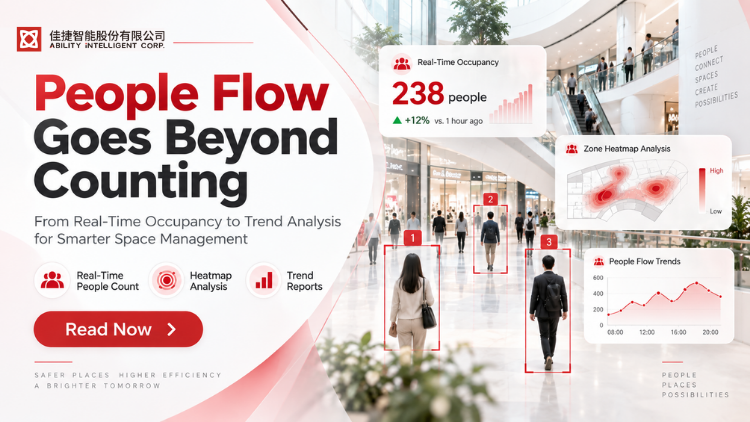
In high-traffic environments such as shopping malls, transportation hubs, exhibition venues, campuses, and public spaces, knowing "how many people are here right now" is only the most basic layer of people flow management. If managers only know how many people entered through a particular entrance on a given day, they can understand basic traffic volume, but it is still difficult to answer more operational questions: Which areas are most likely to become crowded? At what times does traffic begin to increase? Is foot traffic evenly distributed across different entrances? Which spaces remain highly utilized for extended periods? And when large crowds begin to form, how can on-site staffing and circulation routes be adjusted in advance?
The value of AI-powered people flow analytics lies in transforming simple "counting" into data that can be continuously monitored, compared, and analyzed. Through AI video analytics, multi-object tracking, heatmap analysis, and historical reporting, management teams can not only monitor real-time occupancy but also understand long-term traffic patterns, space utilization, and peak-hour trends to support operational and safety management. Ability Intelligent's People Counting system currently supports entry and exit counting, movement flow analysis, crowd density analysis, historical data reporting, and centralized management across different sites.
How Does AI People Flow Analytics Count People?
Traditional people counting may rely on manual counting, infrared sensors, or simple entry and exit triggers. However, these methods typically provide limited visibility into where people are located, how they are moving, or whether crowding is occurring within a space.
AI-powered people flow analytics first captures live video through cameras, then uses deep learning models to detect individuals within the scene and support accurate people counting and movement analysis, even when multiple people appear simultaneously in crowded environments. Combined with multi-object tracking, the system continuously analyzes each person's movement path. Even when multiple people appear in the frame at the same time, the system can further calculate entry and exit counts, real-time occupancy within designated areas, and movement direction.
The overall process can generally be divided into the following steps:
-
- Cameras capture live on-site video
- AI models detect people within the scene
- Multi-object tracking analyzes individual movement directions and trajectories
- The system calculates entry and exit counts and real-time occupancy within designated areas
- Data from different time periods and zones is consolidated
- Heatmaps, trend charts, and historical reports are generated
People flow analytics therefore goes beyond determining "how many people are visible in the frame." Its real purpose is to convert information about time, location, and movement into data that can be continuously used for management and analysis.
Key Factor 1: Real-Time Occupancy Is Only the Starting Point — You Also Need to Know Where People Come From and Where They Go
A single occupancy figure usually tells managers only what is happening at that particular moment. For example, knowing that a shopping mall currently has 1,000 visitors provides a general sense of overall traffic. However, without further information about entrances, floors, specific zones, or movement direction, it is still difficult to determine where crowds are beginning to build.
Through multi-object tracking and movement flow analysis, the system can further observe how people move within a space and how traffic changes between different entrances and areas. Ability Intelligent's People Counting system supports entry and exit counting, occupancy statistics by zone, and movement flow analysis, while also enabling continuous tracking of multiple people in crowded environments.
This information can help management teams answer more practical questions, such as:
-
- Which entrance has the highest traffic volume?
- Which areas receive the most foot traffic?
- At what times does a noticeable increase in traffic begin?
- Are there specific circulation routes where crossing flows or congestion frequently occur?
Once people counting expands from simple entry and exit statistics to movement flow analysis, the data becomes much more relevant to actual space management.
Key Factor 2: A Large Crowd Is Not Necessarily the Problem — What Matters Is Where Density Becomes Too High
In large-scale environments, an increase in total occupancy does not necessarily mean that a safety issue has already occurred. What often requires closer attention is whether people are becoming concentrated in a specific area. For example, the total attendance in an exhibition venue may still remain within an acceptable range, but a particular booth, entrance, or corridor may suddenly experience heavy crowding and become difficult to navigate. Similarly, transportation hubs may experience temporary crowd surges when a train arrives or when a large event ends.
AI people flow analytics can use crowd density and heatmap analysis to visualize areas where people are concentrated and issue alerts based on predefined crowding thresholds. The system can also identify abnormal people flow situations such as crowd gathering, prolonged lingering, or movement in an unexpected direction. This means management teams no longer need to look only at "how many people visited today." Instead, they can understand:
Where people are currently concentrated, whether the level of concentration is abnormal, and whether immediate crowd diversion or on-site adjustments are required.
Key Factor 3: Accumulating Daily People Flow Records Reveals the Trends That Matter
Real-time people flow information is mainly used to understand what is happening "right now." For operational management, however, long-term data can often provide even greater value.
By continuously recording occupancy, entry and exit volumes, and space utilization at different times of the day, organizations can gradually identify recurring peaks and low-traffic periods.
For example:
-
- Shopping malls can compare weekday and weekend traffic patterns
- Exhibition venues can analyze entry and exit rates during different event periods
- Campuses and business parks can track people flow during work hours, lunch breaks, and end-of-day periods
- Public facilities can understand actual utilization levels across different areas
- Transportation hubs can compare passenger volumes and crowd concentration across different time periods
A People Counting system can provide daily, weekly, and monthly reports and present traffic changes through trend charts, maps, and heatmaps. As historical data accumulates, it can also support further analysis of peak periods and potential crowd movement trends.
People flow analytics is therefore not just about displaying a real-time dashboard. It is about transforming continuously accumulated on-site information into historical data that can be compared and analyzed over time.
Key Factor 4: Can People Flow Data Become Part of the Actual Management Process?
Even when a system collects large volumes of people flow data, its practical value remains limited if that information stays isolated within a single platform.
A more important step is connecting real-time occupancy, crowd density, and trend data with existing space management workflows. For example, when the number of people in a designated area approaches a predefined threshold, the system can notify management personnel to begin crowd diversion. In large events or transportation hubs, people flow information can also be integrated with digital signage, public address systems, or security systems to support actual on-site guidance and response measures.
Over the long term, people flow data can also support:
-
- Workforce scheduling and staffing allocation
- Space and tenant layout optimization
- Entrance, exit, and circulation route planning
- Resource deployment during peak periods
- Space utilization analysis
- Crowd safety management for large-scale events
A truly valuable people flow system does more than provide a headcount. It enables data to directly support operational decisions.
Where Can People Flow Analytics Be Applied?
Different environments have different requirements for people flow data, so the focus of people flow analytics should also vary according to the management scenario.
In retail environments and shopping malls, organizations can go beyond daily visitor counts to analyze customer traffic at different times, major movement routes, and high-traffic areas. These insights can support space planning, operational adjustments, and workforce allocation.
At transportation hubs such as railway stations, metro stations, and airports, the management focus is more closely related to crowd movement and safety. Real-time occupancy, zone density, and peak-period analysis can help operators identify areas where crowds are forming and adjust circulation routes or deploy staff for crowd diversion when necessary.
Exhibitions, concerts, and large-scale events often experience significant entry and exit volumes within short periods. Real-time occupancy and zone density information can help venue operators monitor crowd conditions at entrances, corridors, and activity areas, reducing the risk of excessive congestion in localized areas.
For public buildings, schools, campuses, industrial parks, and other large facilities, people flow data can help organizations understand how different spaces are actually being used. For example, it can reveal which areas are used most frequently and when people tend to gather, providing a data basis for space management, staffing allocation, and operational planning.
There is therefore no single fixed way to apply people flow analytics. The key is to first identify the management problem within the environment, and then determine whether the organization needs to measure entry and exit volumes, movement patterns, zone density, or long-term traffic trends.
Moving from "How Many People Are Here Today?" to Long-Term Space Management
The most intuitive function of people flow analytics is counting people, but counting is only the first step in the overall process.
When real-time occupancy is combined with entry and exit volumes, movement direction, crowd density, heatmap distribution, and historical trends, what was originally a simple number can gradually become a data foundation for operational and safety management.
Before implementing a people flow analytics system, organizations can begin by evaluating the following areas:
-
- Which entrances, exits, and zones need to be monitored
- Whether movement direction and traffic flow patterns need to be analyzed in addition to total occupancy
- Which areas require crowd density or congestion monitoring
- Whether real-time people flow information needs to trigger notifications, public announcements, or other management actions
- Whether daily, weekly, and monthly historical data needs to be retained
- Whether multiple sites may need to be centrally managed in the future
Ability Intelligent's People Counting system is built on AI video analytics and multi-object tracking, integrating real-time occupancy, movement flow, density analysis, and historical reporting within a unified people flow management architecture. It also supports integration with existing cameras, edge computing, and multi-site management.
From real-time occupancy to long-term trend analysis, the real transformation brought by people flow analytics is not simply the automation of manual counting. It is the conversion of movement information that was previously difficult to continuously organize into data that can be searched, compared, and analyzed.
When management teams can simultaneously understand "how many people are here now," "where people are concentrated," and "where the crowd may move next," people flow data evolves from a basic statistical tool into a valuable foundation for operational management, safety planning, and resource allocation.

Want to learn more about AI Container Recognition, Smart Logistics, and AI Image Recognition applications?
Follow Ability Intelligent on Facebook for the latest industry insights and updates.
