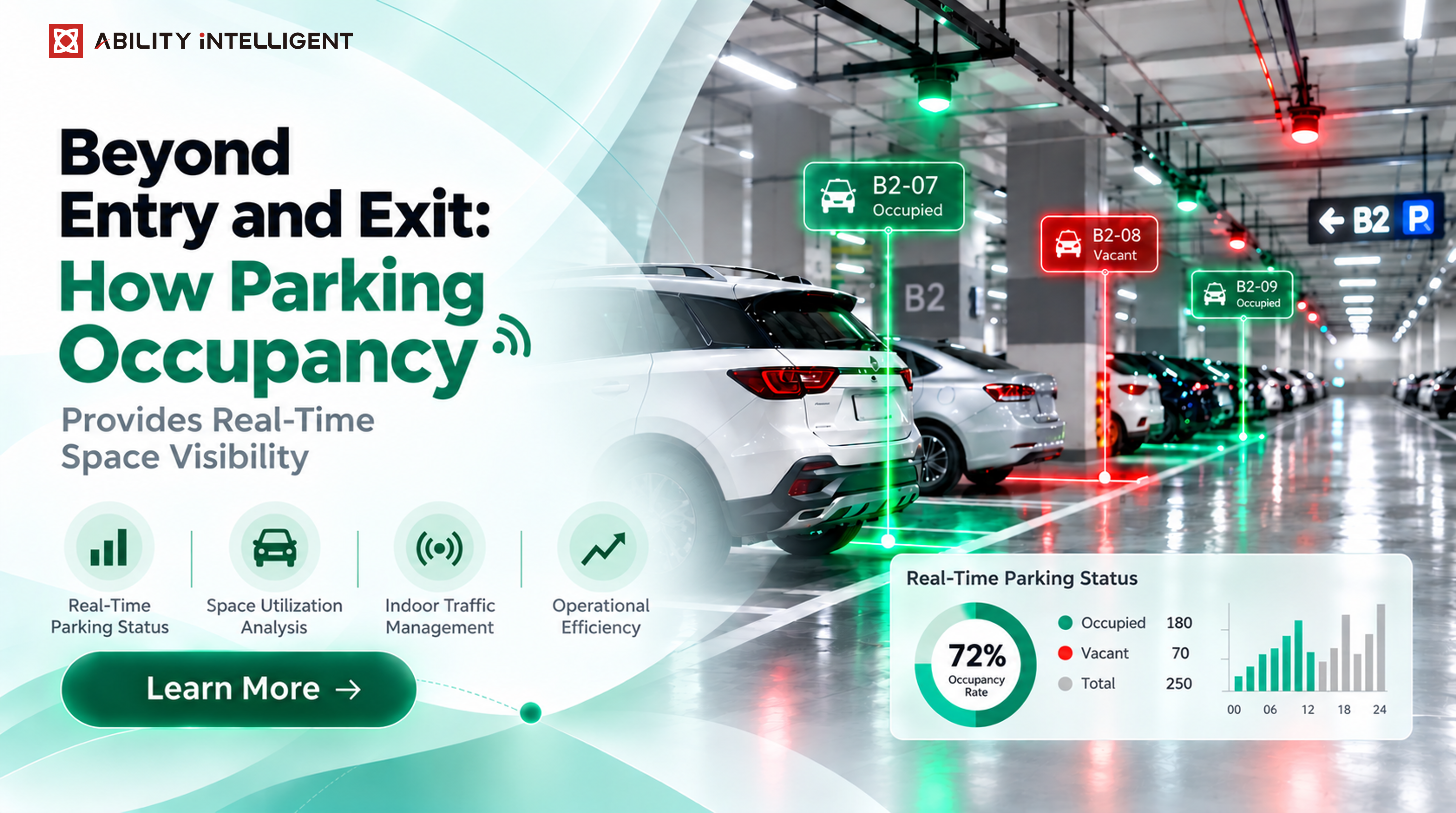
In shopping malls, office buildings, residential communities, and public parking facilities, parking management involves more than vehicle entry and exit. Drivers need to find available parking spaces quickly, while operators need to monitor parking conditions in real time.
Even with license plate recognition, automatic barrier gates, and payment kiosks, drivers may still spend time searching for parking if available spaces are not clearly identified.
A smart parking system combines parking occupancy detection, guidance equipment, and a management platform to provide real-time parking availability information. Drivers can find spaces more efficiently, while operators can monitor occupancy across different floors and areas, improving overall parking management.
How Does Parking Occupancy Detection Work in a Smart Parking System?
Effective parking management requires more than counting incoming vehicles. It also needs to identify which parking spaces are occupied and which remain available.
Parking occupancy detection uses AI video analytics or ultrasonic sensors to identify space availability and transmit the results to a management platform or on-site displays.
The process generally involves the following steps:
-
- Data Collection: AI cameras or ultrasonic sensors collect parking space information.
- Occupancy Detection: The system identifies occupied and available spaces.
- Data Transmission: Detection results are sent to the management platform or control equipment.
- Real-Time Guidance: Parking indicator lights and guidance displays are updated.
- Data Monitoring: The platform collects occupancy and utilization data from different areas.
Different devices use different detection methods. The AI Parking Guidance Camera (AI PD) uses AI video analytics to identify occupied spaces, while the Ultrasonic Parking Guidance Light combines ultrasonic sensing with LED indicators to display parking availability.
These technologies help operators understand not only how many spaces are available but also where they are located.
Key Benefit 1: Help Drivers Find Available Parking Spaces Faster
Drivers want to find parking quickly. If a system only shows the total number of available spaces without indicating their locations, drivers must still search through different parking areas.
Parking occupancy detection updates space status in real time. Combined with parking guidance signs and indicator lights, it helps drivers locate available spaces more efficiently.
In multi-level parking garages, the management platform can display available spaces across different floors and areas. Operators can also identify areas approaching full capacity and guide drivers toward less occupied zones, reducing unnecessary driving and improving traffic flow within the facility.
Key Benefit 2: Make Parking Availability Visible with Ultrasonic Lights and AI Cameras
Accurate detection is only part of an effective parking guidance system. Drivers also need clear information about which spaces are available. The Ultrasonic Parking Guidance Light combines ultrasonic sensors with LED indicators to detect whether a vehicle occupies a parking space and display its status.
For example, a red light typically indicates an occupied space, while a green light indicates an available space, depending on the device configuration. Drivers can identify vacant spaces at a glance without checking each space individually. Alternatively, the AI Parking Guidance Camera uses AI video analytics to detect parking occupancy. The results can be displayed through LED indicators or parking guidance signs.
The two technologies differ in detection methods, installation requirements, and equipment configuration. The appropriate choice depends on the parking environment, space layout, and system requirements. Both approaches aim to provide clearer parking information for drivers and easier space management for operators.
Key Benefit 3: Turn Real-Time Occupancy Data into Long-Term Parking Insights
Real-time availability helps drivers find spaces, while historical data helps operators understand parking demand over time. By connecting parking occupancy detection to a parking management system, operators can collect occupancy records and, where supported, combine them with vehicle entry and exit data.
This enables analysis of parking utilization across different time periods, floors, and areas, including:
-
- Parking occupancy rates and space turnover
- Peak parking hours and demand patterns
- Space utilization across floors and zones
- Usage of reserved, accessible, and EV charging spaces
For example, shopping malls can compare weekday and weekend parking demand, office buildings can monitor morning and evening peak periods, and public parking facilities can analyze space utilization across different areas.
AI parking occupancy detection can also support the management of accessible parking spaces, EV charging spaces, and reserved spaces. When integrated with appropriate management mechanisms, the system can help detect and manage abnormal occupancy events, including unauthorized use of designated parking spaces. These insights help operators identify high-demand areas and peak periods, supporting better parking guidance, space planning, and operational decisions.
Key Benefit 4: Integrate Parking Equipment for More Efficient Operations
A smart parking system works best when its equipment is connected, creating a more efficient process from entry to exit.
Depending on site requirements, an integrated solution can include:
-
- Automatic Barrier Gates: Control vehicle entry and exit.
- License Plate Recognition (ANPR) Systems: Identify vehicles and record entry and exit information.
- AI Parking Guidance Cameras: Use AI video analytics to detect parking occupancy and support parking guidance.
- Ultrasonic Parking Guidance Lights: Combine ultrasonic sensing with LED indicators to display parking availability.
- Automated Payment Kiosks: Provide parking fee payment services.
- Smart Parking Bollards: Control access to designated parking spaces or areas.
AI Parking Guidance Cameras and Ultrasonic Parking Guidance Lights can be selected according to site conditions and operational requirements. Both technologies do not necessarily need to be installed together.
Integrating these devices with a centralized management platform connects vehicle access, parking guidance, occupancy monitoring, and payment processes. This improves convenience for drivers while reducing the daily workload of parking operators.
Where Can Parking Occupancy Detection Be Applied?
Parking occupancy detection supports different management needs across a range of facilities.
-
-
Shopping Malls and Retail Centers: Real-time parking information helps drivers find spaces faster and allows operators to monitor demand during weekends and peak hours. Data from different floors and areas also supports better parking guidance and space planning.
-
Office Buildings and Corporate Campuses: Integration with license plate recognition and access control systems helps operators monitor parking usage by employees, visitors, and authorized users. Fixed, temporary, and reserved spaces can be managed according to site requirements.
-
Residential Communities: Connecting parking occupancy detection with vehicle access systems helps operators monitor space usage by residents and visitors, including reserved spaces, while reducing manual checks and simplifying daily management.
-
Public Parking Facilities and Transportation Hubs: Real-time detection and guidance displays help operators identify available spaces and direct drivers toward less occupied areas, improving traffic flow and parking efficiency during busy periods.
Before deployment, operators should identify their main challenges, such as long parking search times, frequently occupied areas, difficulties managing reserved spaces, or limited parking data. The appropriate detection technology and system configuration can then be selected based on the parking layout, existing equipment, and management requirements.
From Entry and Exit Control to Smarter Parking Management
A smart parking system goes beyond vehicle access and payment by helping drivers find available spaces and giving operators real-time visibility into parking conditions. When planning a smart parking system, operators should evaluate their occupancy monitoring needs, detection technology options, and requirements for parking guidance, access control, and payment integration.
Ability Intelligent provides integrated smart parking solutions tailored to different facilities, combining AI Parking Guidance Cameras, Ultrasonic Parking Guidance Lights, license plate recognition systems, and other parking equipment based on site requirements.
By integrating real-time occupancy data with historical records, operators can improve parking guidance, optimize space utilization, and enhance operational efficiency. Explore Ability Intelligent's AI Parking Guidance Camera to learn more about real-time parking occupancy detection and intelligent parking guidance.

Want to learn more about Smart Buildings, AI Video Analytics, and AIoT applications?
Follow Ability Intelligent on Facebook for the latest industry insights and updates.
