.png)
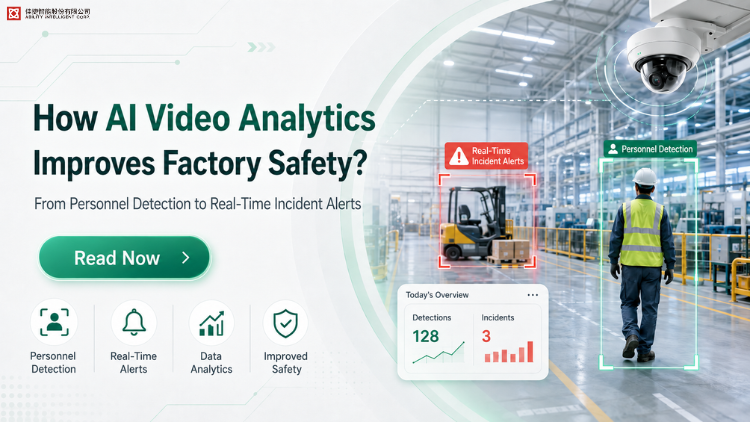
Factory surveillance systems generate large volumes of video footage every day, yet only a small number of incidents typically require immediate attention from management personnel. Unauthorized entry into restricted areas, vehicles entering prohibited zones, unattended objects, prolonged loitering, and even smoke detection can all develop into safety risks within a short period of time.
Relying entirely on personnel to continuously monitor multiple video feeds not only requires significant manpower, but also makes it difficult to ensure that every incident is identified as soon as it occurs. AI video analytics enables surveillance systems to go beyond simply recording footage by adding the ability to detect targets, analyze events, and proactively issue alerts.
How Does AI Video Analytics Understand What Is Happening on the Factory Floor?
AI video analytics does more than simply determine whether a person is present in the frame. Once a camera captures live video, the system first detects people, vehicles, or other objects, and then analyzes them based on predefined zones, event conditions, and duration thresholds.
For example, a virtual boundary can be established around an equipment operating area or restricted warehouse zone. When a person enters the defined area, the system can determine whether the event meets preset conditions. If someone remains in a sensitive area for too long, crosses a designated boundary, or if an unusual object appears, the system can trigger the corresponding alert.
Ability Intelligent’s incident detection system currently supports multiple event types, including intrusion, loitering, illegal parking, line crossing, crowd anomalies, and unattended objects. The core value of AI video analytics is therefore not simply to “see a person,” but to help the system understand: who or what is present, where it is located, what is happening, and whether the situation requires intervention by management personnel.
Key Factor 1: Determining Whether Personnel Enter High-Risk or Restricted Areas
Different areas within a factory often require different levels of safety control. General walkways may allow normal access, while machinery operation zones, restricted warehouse areas, high-risk equipment zones, and other controlled areas may only be accessible to authorized personnel.
With AI video analytics, virtual fences or designated zones can be defined directly within the surveillance image. When a person or vehicle crosses a predefined boundary, the system can automatically generate an event without requiring additional physical fencing.
The key is not simply identifying whether someone is present, but connecting the target’s location with specific site rules. The same worker may be considered part of normal operations when walking through a general corridor, but once that person enters a restricted area, the system can immediately convert the video footage into a safety event that requires attention.
Key Factor 2: Extending Detection from Individual Targets to Abnormal Behavior and Environmental Events
Factory safety incidents are not limited to unauthorized entry. Some risks are caused by people or vehicles remaining in an area for too long, while others involve unusual objects, unauthorized occupation of space, or changes in the surrounding environment.
Incident detection systems can identify events such as loitering, illegal parking, unauthorized occupation, line crossing, crowd anomalies, and unattended objects.
In addition, AI-enabled cameras can support event detection such as stopped vehicles, pedestrian intrusion, wrong-way movement, scattered objects, and smoke detection, allowing deployment to be adapted to different site requirements.
When implementing AI video analytics, companies can therefore establish different rules according to the risk profile of each area.
For example:
- Warehouse areas can focus on personnel access and abnormal loitering
- Loading and unloading zones can focus on stopped vehicles and unauthorized occupation
- Factory perimeters can focus on intrusion and boundary-crossing detection
- Special environments can focus on smoke and abnormal object detection
By configuring the system according to actual site conditions, each camera can provide greater operational and safety value.
Key Factor 3: Can the Right Personnel Be Notified Immediately When an Incident Occurs?
Detecting an abnormal event is only the first step. If personnel still need to manually search through recorded footage after the system identifies an incident, much of the operational value of AI is lost.
An effective video analytics system therefore needs to connect event detection with notification and response workflows.
For example, when an abnormal event occurs, the system can immediately generate an alert and integrate with access control systems, alarm devices, and smart surveillance platforms. AI IID object-detection cameras can also transmit event information through event management systems, electronic maps, real-time video monitoring, and API-based alert notifications.
If an unauthorized person enters a restricted area, for instance, the management center can immediately receive an event notification together with the corresponding live image, helping reduce response time.
Effective smart surveillance is not only about allowing AI to recognize that something unusual has happened. It is about ensuring that the incident can quickly enter the organization’s existing response and management process.
Key Factor 4: Can Incident Data Be Retained and Used for Ongoing Safety Management?
Traditional surveillance footage is usually searched primarily by time. When managers want to understand which areas are frequently affected by unauthorized entry or which periods experience more abnormal loitering, reviewing large amounts of recorded video can require considerable time.
AI video analytics can convert incidents into structured information that can be categorized and searched.
In addition to supporting historical video playback, incident tracking, data reports, and personnel or vehicle movement records, the system can also integrate real-time and historical information to support incident analysis and follow-up management.
These records can be used not only for investigating individual incidents, but also for continuously improving factory safety strategies over time.
What Systems Need to Work Together When Deploying AI Video Analytics in a Factory?
In practice, AI video analytics involves more than installing a single camera. A complete architecture typically begins with front-end cameras capturing video, followed by AI computing devices and backend systems analyzing the footage, with event results ultimately presented through a centralized management platform.
Ability Intelligent’s smart surveillance management solution adopts an integrated architecture consisting of front-end devices, server-side infrastructure, and a management center platform.
Network cameras and other sensing devices can be deployed at the site, while the server side manages video streaming, recording and archiving, event management, real-time alerts, and historical playback. APIs can also be used to integrate the system with other existing platforms.
For environments that require simultaneous analysis of multiple video streams, AI computing devices or backend server architectures can be deployed to support video analytics, incident detection, and centralized management.
When planning AI video analytics for factory environments, organizations should consider the following:
- Which areas require incident detection
- Which types of incidents need to be identified in each area
- Which personnel should be notified when an incident occurs
- Whether integration with existing access control, alarm, or management platforms is required
- How incident data should be stored and retrieved
The goal is not to equip every camera with the maximum number of functions, but to deploy the right detection capabilities in the right locations.
Moving from Passive Video Monitoring to Proactive Safety Management
The value of AI video analytics lies not only in adding more detection capabilities to surveillance cameras, but in changing how factories use video data.
From personnel and vehicle detection to zone-based rules, abnormal event detection, real-time alerts, and historical data analysis, AI video analytics can help establish a more comprehensive safety management process.
When evaluating AI video analytics for factory environments, organizations can begin with four key questions:
- Which people, vehicles, or objects need to be detected?
- Which behaviors or situations should be defined as abnormal events?
- How should incidents be communicated and handled in real time?
- Can incident data be stored, searched, and continuously analyzed?
The value of surveillance systems therefore extends beyond reviewing footage after an incident has occurred. AI video analytics enables video to be transformed into actionable management information at the moment an event happens, helping organizations respond more quickly to on-site conditions and build a more proactive and real-time approach to factory safety management.

Stay ahead with the latest industry insights and innovations in AI-powered vision.
Follow Ability Enterprise on Facebook for the latest news and updates.
