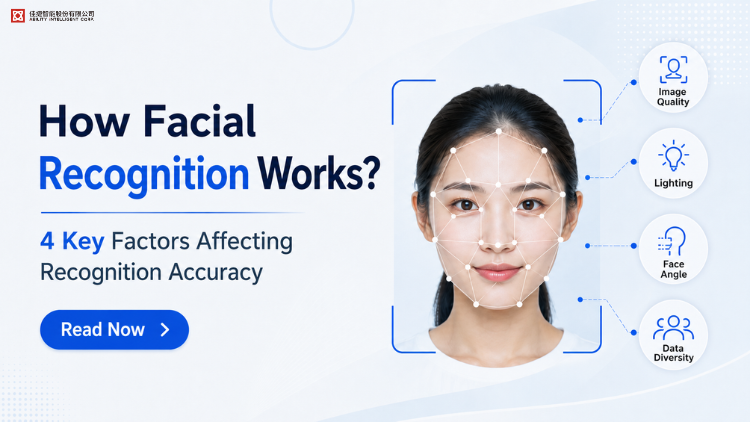
Entering an office building, factory, or residential complex no longer has to involve presenting an access card. By simply approaching the entrance, a facial recognition system can identify the user and activate the appropriate access permissions.
Although the process may appear simple, it involves multiple steps, including face detection, image processing, feature extraction, database matching, and access control.
For this reason, the performance of a facial recognition system depends not only on the AI algorithm itself, but also on camera conditions, enrollment data quality, the actual operating environment, and how the system is integrated with existing management processes.
How Does Facial Recognition Identify a Person?
Facial recognition does not simply place two photos side by side and decide whether they look similar.
Once the camera captures an image, the system first detects the face in the frame. It then processes factors such as facial angle, brightness, and alignment. An AI model analyzes the facial features and converts the image into a set of digital data that can be used for matching.
The system then compares the live facial data with the records stored in the database. Once the matching result meets the system’s preset conditions, it performs the appropriate action based on the user’s permissions, such as unlocking a door, recording attendance, issuing an event alert, or saving an access log.
Facial recognition is generally used in two ways.
One-to-one verification confirms whether a person is the specific individual they claim to be. For example, an employee may present an access card and then complete facial verification as a second step.
One-to-many identification compares a live face against an entire database to identify the person directly. This is commonly used for cardless access control, member identification, visitor management, and watchlist applications.
The entire process can be completed in a short period of time. However, stable real-world operation still depends on four key factors.
Factor 1: Whether the Camera Captures a Clear Facial Image
The first requirement for facial recognition is a usable facial image.
If the face appears too small in the frame, the person is moving too quickly, the camera is installed at an unsuitable angle, or the site has strong backlighting, shadows, or insufficient nighttime illumination, the system may have difficulty processing the facial features.
A camera that can capture a person is not necessarily suitable for facial recognition. Camera placement should be planned according to walking direction, recognition distance, movement speed, and lighting conditions.
For example, an office entrance usually has more stable lighting and a predictable traffic flow. A factory or outdoor site may need to handle direct sunlight, shadows, rain, safety helmets, and fast-moving personnel. These conditions may require different camera positions, lens configurations, or supplementary lighting.
Factor 2: Whether Enrollment Data Is Clear and Consistent
The quality of the reference images stored in the database is just as important as the live camera image.
Low-resolution photos, tilted faces, uneven lighting, or images cropped from group photos may increase the difficulty of identification and data management. Heavily edited images, outdated photos, or duplicate records may also make the database less reliable.
A consistent enrollment process should therefore be established. Reference images should be front-facing, clear, evenly lit, and show the full face. They should also be updated when a person’s appearance changes significantly.
The goal is not simply to collect more photos. What matters is whether the data is clear, valid, and supported by a standard process for adding, updating, and deactivating records.
Factor 3: Whether the System Fits the Actual Operating Environment
Different sites have different requirements for facial recognition.
A typical office entrance may involve one person at a time moving in a fixed direction. A factory or large facility may need to handle multiple people, moving subjects, partial side profiles, changing lighting conditions, or facial obstruction caused by masks and safety helmets.
This means that a facial recognition project should not be evaluated solely by individual device specifications. The cameras, AI model, computing equipment, and site layout must work together as one system.
Before full deployment, testing should be conducted at the planned installation location. The system should be evaluated under different lighting conditions, at different times of day, and during normal pedestrian movement.
For more complex environments, a proof of concept can be used to confirm whether the overall system architecture is suitable before deployment is expanded.
Factor 4: Whether Access Permissions and Management Processes Are Complete
The purpose of facial recognition is usually not limited to displaying a person’s name. The recognition result often needs to trigger a wider business or security process.
For example, the system may apply different access permissions, open a specific gate, record attendance, issue a watchlist alert, or send event data to an existing management platform.
A complete facial recognition project should therefore define:
- Who is authorized to add or update facial records
- Which areas each user is permitted to enter
- What information should be stored in access logs
- Who should receive notifications when an exception occurs
- What alternative verification method should be used when identification cannot be completed
A general office area may use an access card or visitor QR code as an alternative. A server room, laboratory, or restricted area may require facial recognition combined with a card, password, or another authentication method.
A well-designed facial recognition system should support not only identity recognition, but also clear management of permissions, events, and operating records.
Where Can Facial Recognition Be Applied?
Facial recognition technology can be used in office buildings, factories, residential communities, campuses, healthcare facilities, transportation hubs, and government organizations.
Common applications include cardless access control, employee attendance, visitor management, watchlist management, restricted-area control, and event alerts.
The system can also be integrated with existing access control, attendance, elevator, surveillance, or enterprise management platforms. This reduces duplicate data entry and minimizes the need for manual verification across separate systems.
Ability Intelligent’s FR Facial Recognition System can integrate facial identification, watchlist management, access control, event alerts, and record searches based on site requirements. It can also work with edge computing devices and existing management platforms, allowing recognition results to support broader access and security workflows.
Conclusion
Facial recognition may appear to be a simple process of allowing a camera to identify a person. In practice, it involves multiple elements, including image capture, data enrollment, site planning, and backend management.
The four key factors that influence real-world system performance are:
- Whether the camera captures a clear facial image
- Whether enrollment data is clear and consistent
- Whether the system fits the actual operating environment
- Whether access permissions and management processes are complete
Before deployment, organizations should evaluate lighting conditions, pedestrian flow, database size, operational goals, and existing system architecture.
This makes it possible to select the appropriate equipment and deployment method, allowing facial recognition to become a stable, convenient, and manageable identity verification solution.

Stay ahead with the latest industry insights and innovations in AI-powered vision.
Follow Ability Enterprise on Facebook for the latest news and updates.
