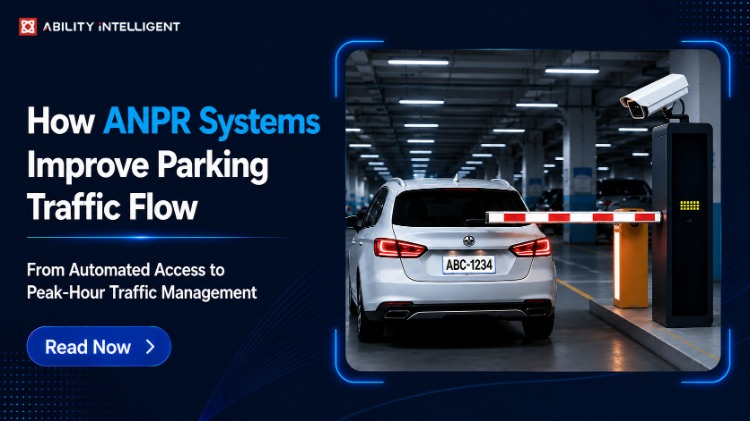
Managing a parking facility is about more than available parking spaces. During peak hours, a high volume of vehicles can quickly cause entrance queues, exit congestion, and unnecessary circulation as drivers search for available spaces.
By integrating ANPR/LPR license plate recognition, parking barriers and lane control, parking occupancy detection, and related systems through a Smart Parking Management Solution, parking facilities can achieve automated access, real-time monitoring, and more efficient traffic management.
ANPR/LPR Enables Fast, Automated Parking Access
ANPR/LPR (Automatic Number Plate Recognition / License Plate Recognition) is a key technology for smart parking automation.
The system automatically captures and recognizes license plates at entrances and exits, then verifies access permissions for monthly parking users, visitors, or other authorized vehicles.This reduces the need for tickets, cards, and manual checks.
For industrial parks, office buildings, and residential communities, ANPR/LPR helps reduce vehicle stopping time and improve lane efficiency during peak hours.
Parking Barriers and Lane Control Improve Access Efficiency
License plate recognition alone does not complete the access process. Parking barriers and lane control systems are needed to authorize and manage vehicle entry and exit.
After ANPR/LPR verifies a vehicle, the barrier can open automatically for authorized vehicles. Unrecognized or unauthorized vehicles can be flagged for manual verification.
By connecting vehicle recognition, access verification, and barrier control, parking facilities can reduce manual intervention and improve traffic flow.
How the Smart Parking Management Solution Helps Manage Traffic Data and Peak Hours
By integrating ANPR/LPR entry and exit data through the Smart Parking Management Solution, operators can gain a clearer view of overall parking operations.
Managers can monitor:
-
- Vehicle entry and exit
- Number of vehicles inside
- Parking duration
- Peak-hour traffic
- Weekday and weekend patterns
- Traffic during special event
This data helps operators understand traffic patterns and use historical and real-time data to prepare lane configurations and on-site management in advance, rather than responding only after congestion occurs.
Parking Occupancy Detection Reduces Parking Search Traffic
Finding an available parking space can also create congestion.
When drivers circle a parking facility looking for an open space, parking search time increases and internal traffic becomes less efficient.
With parking occupancy detection and parking guidance systems, operators can monitor parking space availability in real time and guide drivers toward available areas.
This reduces unnecessary circulation and improves parking efficiency.
What Core Equipment and Systems Can the Smart Parking Management Solution Integrate?
A Smart Parking Management Solution goes beyond a single device. Based on site requirements, it integrates hardware and software for vehicle identification, access control, parking occupancy detection, and operational management.
Hardware
-
- ANPR/LPR Cameras – License plate recognition and vehicle identification
- Parking Barriers & Lane Control – Automated vehicle access
- Parking Occupancy Sensors – Real-time parking space detection
- On-site Equipment – Supporting access and parking operationsSoftware
Software
-
- Parking Management System – Centralized management of license plate data, entry and exit records, access permissions, and operational analytics
Together, these components help operators turn on-site data into useful information for traffic and parking operations.
Smart Parking Management Solution Applications in Taiwan
Different facilities in Taiwan face different parking and traffic challenges. Smart parking systems can help manage high-volume vehicle flow and improve parking efficiency.
-
-
Science Parks:
Manage large volumes of monthly parking vehicles during commuting hours.
-
Corporate Offices:
Automate access for employees and authorized vehicles.
-
Shopping Malls:
Handle weekend, holiday, and promotional traffic peaks.
-
Tourist Attractions:
Manage holiday traffic surges and full-capacity conditions.
-
Event Venues:
Improve vehicle flow during concentrated exit periods.
5 Key Considerations Before Implementing a Smart Parking Management Solution
Before implementing a Smart Parking Management Solution, operators should evaluate the site's traffic patterns, parking requirements, and existing infrastructure.
-
-
Traffic Volume
Analyze weekday, weekend, and peak-hour traffic to determine the required number of lanes and equipment.
-
Lane and Site Conditions
Evaluate entrances, exits, lane layout, lighting, and day/night conditions to ensure reliable ANPR/LPR performance.
-
Vehicle Access Requirements
Define access requirements for annual/monthly permit holders, visitors, and other authorized vehicle types.
-
Existing Equipment Integration
Check existing parking barriers, access control, payment systems, and other existing parking-related systems to determine integration requirements.
-
Future Expansion
Consider future needs such as additional lanes, parking spaces, or equipment. A scalable architecture provides greater flexibility for future expansion and system integration.
Build a Smarter Parking Operation
A Smart Parking Management Solution goes beyond equipment installation. By evaluating site traffic flow, operational needs, existing systems, and future scalability, operators can develop a suitable smart parking management architecture to improve operational efficiency and overall management effectiveness.

Interested in smart parking and AI vision applications?
Follow Ability Intelligent on Facebook for the latest industry insights and updates.
