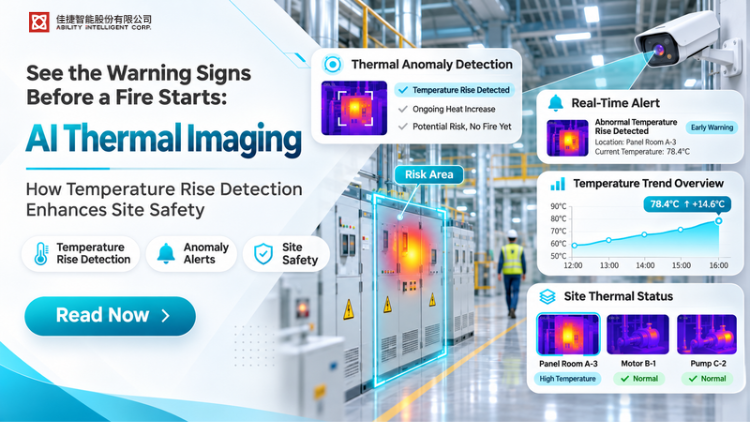
In industrial facilities, logistics warehouses, and power installations, certain safety risks may develop before visible smoke or flames appear. Equipment overheating, localized temperature increases, and abnormal heat sources can provide early indications that further inspection is needed. For example, abnormal heating at electrical connections, excessive friction in operating machinery, or unusual heat accumulation in storage areas may signal potential hazards.
Traditional surveillance cameras primarily capture visible-light images, making them suitable for monitoring personnel activities, equipment conditions, and surrounding environments. However, they cannot directly reveal temperature differences that are invisible to the human eye. When an abnormal condition has not yet produced visible smoke or physical changes, management personnel may be unable to identify the warning signs through conventional video monitoring alone.
AI thermal imaging technology uses infrared sensors to capture thermal radiation emitted by objects. By combining temperature anomaly analysis, hotspot detection, and real-time alerts, it helps organizations continuously monitor temperature changes in high-risk areas. This provides an opportunity to identify abnormal thermal conditions before a fire develops or spreads.
How Can AI Thermal Imaging Detect Abnormalities That Conventional Cameras Cannot See?
Conventional visible-light cameras rely on light to capture images, primarily showing the appearance, colors, and activities of objects within a scene. Thermal imaging cameras, on the other hand, detect infrared radiation emitted by objects to generate thermal images, allowing differences in surface temperature distribution to be observed and analyzed.
For example, a motor operating continuously may appear normal from the outside. However, if the temperature of a particular component gradually increases, thermal imaging may reveal an unusual heat distribution compared with the surrounding areas, helping maintenance personnel identify potential overheating.
Thermal imaging can also capture thermal information in environments with little or no visible-light illumination, making it suitable for nighttime operations, low-light conditions, and areas requiring continuous heat source monitoring.
However, thermal imaging cannot see through all physical obstructions. Actual detection performance is influenced by factors such as camera distance, surface materials, environmental conditions, and line-of-sight obstructions.
From High Temperatures to Continuous Temperature Increases: How Does AI Identify Abnormal Heat Sources?
Not every high-temperature reading indicates a safety risk. Heating equipment, operating machinery, and electrical components may naturally reach elevated temperatures during normal operation. Effective temperature anomaly detection must therefore consider equipment characteristics and actual operating conditions.
AI thermal imaging systems can analyze hotspots, sustained high temperatures, and rapid temperature increases within designated monitoring areas, identifying conditions that require attention based on predefined detection criteria.
Common monitoring capabilities include:
-
- Abnormal Temperature Detection: Monitoring whether surface temperatures in designated areas or equipment exceed predefined thresholds.
- Temperature Rise Analysis: Tracking temperature changes at specific locations to help identify gradually developing abnormal heat sources.
- Hotspot Distribution Monitoring: Analyzing thermal patterns within monitored areas to identify localized overheating.
- Early Thermal Anomaly Detection: Providing alerts when abnormal thermal signatures or unusual heat conditions appear that may require further investigation.
For example, if an electrical connection repeatedly exhibits abnormal temperature increases under similar operating conditions, management personnel can review thermal images and temperature records before arranging an inspection to determine whether poor connections, unusual electrical loads, or other equipment issues are present.
Repeated temperature anomalies can also provide valuable indicators for predictive maintenance programs, helping organizations identify equipment deterioration before operational failures occur. The objective is not to classify every high-temperature reading as a fire, but to identify thermal abnormalities that differ from normal operating conditions and may require further investigation.
How Do Dual Thermal and Visible-Light Cameras Help Verify Abnormal Heat Sources?
When thermal imaging identifies an abnormal hotspot, management personnel still need to determine which piece of equipment or area is affected and whether other unusual conditions are present. Ability Intelligent's AI FSD Thermal Imaging Camera features a dual-camera design combining thermal imaging with full-color visible-light imaging. This allows management personnel to compare the location of abnormal heat sources with the corresponding physical environment.
For example, when an unidentified hotspot appears in a warehouse, thermal imaging can reveal the unusual heat distribution, while visible-light footage helps identify nearby goods, equipment, and surrounding structures. Together, these images make it easier for personnel to determine which area should be inspected first.
The value of a dual-camera configuration lies in combining two complementary sources of information: thermal images reveal temperature distribution, while visible-light images help identify physical objects and environmental conditions. Using both can provide a more complete understanding of on-site abnormalities than relying on a single imaging method.
What Happens After an Abnormal Temperature Increase Is Detected?
Once a temperature anomaly is detected, promptly delivering the relevant information to management personnel becomes an important part of thermal imaging safety monitoring. The AI FSD Thermal Imaging Camera supports real-time temperature anomaly alerts, allowing notifications and associated images to be transmitted to a management center or cloud platform. It can also exchange information with fire safety or security management systems through API integration.
Consider an equipment area within a manufacturing facility. When the system identifies a hotspot that meets predefined abnormality conditions, it can generate an alert for personnel to review the thermal images and corresponding on-site footage. Based on established safety procedures, the management team can then arrange equipment inspections, evaluate whether shutdown is necessary, or take other appropriate actions.
In addition to real-time monitoring, historical records provide valuable information for ongoing safety management. The system can generate temperature trend curves, hotspot distribution statistics, abnormal event records, and daily, weekly, or monthly reports, helping personnel identify whether particular equipment or areas repeatedly experience abnormal temperature conditions.
Historical temperature trends can also help distinguish between isolated events and recurring thermal issues that may require long-term corrective actions.
These records can support equipment inspections, maintenance planning, risk assessments, and predictive maintenance initiatives. However, actual response measures should still be determined by qualified personnel based on the specific conditions at the site.
Which Environments Can Benefit from AI Thermal Imaging Safety Monitoring?
Fire risks vary across industries and operating environments, so thermal imaging configurations should be tailored to the specific conditions of each site. In industrial plants and manufacturing facilities, thermal imaging can monitor operating machinery, electrical equipment, and heat-processing areas to help identify abnormal overheating. In substations and electrical facilities, it can be used to monitor temperature abnormalities in critical components such as cables, transformers, and switchgear.
Warehouses and logistics centers may store large volumes of goods or combustible materials. Hotspot monitoring can help personnel identify unusual temperature changes within designated storage areas. In underground parking facilities, public buildings, and transportation hubs, thermal imaging can be incorporated into existing safety monitoring infrastructure according to site requirements, providing thermal information that conventional visible-light cameras cannot directly capture.
Thermal imaging can also be applied to forest and outdoor fire monitoring, helping identify abnormal hotspots or early-stage fire sources within the monitored area. However, detection performance remains dependent on distance, terrain, weather conditions, and camera coverage. Organizations should first identify the primary sources of risk in each environment before determining camera placement, monitoring coverage, and alert conditions, rather than applying identical settings across all locations.
Can Thermal Imaging Replace Conventional Fire Alarm Systems?
Thermal imaging provides valuable information about temperature abnormalities and heat distribution. However, this does not mean that every fire will produce a detectable temperature increase before ignition, nor does an elevated temperature reading necessarily confirm that a fire has occurred.
For example, equipment may generate high temperatures during normal operation, while reflective metal surfaces can affect thermal image interpretation. If an abnormal heat source is located inside equipment, behind a wall, or outside the camera's direct field of view, the system may not be able to detect or fully assess the condition.
Thermal imaging should therefore be regarded as a complementary technology for temperature anomaly monitoring and early risk identification. It should operate alongside fire alarm systems, firefighting equipment, and established safety procedures that comply with applicable regulations, rather than directly replacing legally required fire protection systems.
Before implementation, organizations should also evaluate equipment monitoring locations, normal operating temperatures, abnormality detection criteria, and response procedures. The potential effects of surface materials, reflections, monitoring distance, and environmental conditions on thermal image interpretation should be considered as part of system planning.
Identifying Critical Temperature Changes Earlier for More Effective Safety Management
When safety monitoring relies solely on conventional video footage, management personnel may more readily notice visible smoke, flames, or changes in equipment appearance, while thermal abnormalities without obvious visual signs can remain undetected.
With AI thermal imaging, organizations can continuously monitor temperature distribution across critical equipment and high-risk areas. By combining abnormal temperature rise detection, dual-camera imaging, real-time alerts, and historical records, management teams gain additional information to support safety assessments and incident tracking.
Effective fire prevention requires the coordinated use of equipment monitoring, fire protection systems, routine inspections, and established management procedures. AI thermal imaging contributes an additional layer of visibility within this broader safety framework, helping organizations identify potential problems earlier and take appropriate action while abnormal thermal conditions may still be manageable.
Ultimately, AI thermal imaging helps organizations reduce safety risks, support predictive maintenance initiatives, improve operational resilience, and make more informed decisions about equipment health and site safety. Rather than relying solely on visible signs of trouble, management teams can use thermal information as an additional source of situational awareness, enabling earlier intervention and more proactive risk management.

Want to learn more about Smart Buildings, AI Video Analytics, and AIoT applications?
Follow Ability Intelligent on Facebook for the latest industry insights and updates.
